You Are NOT a Coward: Overcoming Transition Fears and Big Decisions
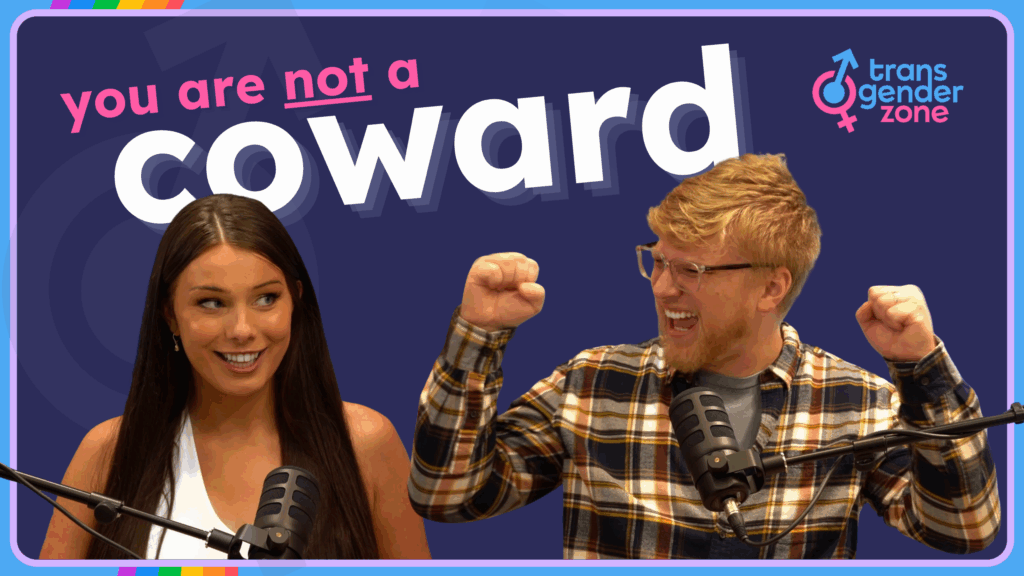
Originally aired on the Transgender Zone Podcast with Victoria and Christopher
Being transgender is scary. Going out in public when you’re not confident in your ability to pass takes courage. It can be physically dangerous and psychologically challenging. Yet too often, transgender people are told they’re “cowards” for not moving fast enough in their transition journey.
This harmful narrative needs to stop. There’s a fundamental difference between cowardice and having legitimate concerns about your safety and wellbeing. As one podcast host shared: “I felt like a coward because I couldn’t go through a haunted house. But that doesn’t actually have any bearing on your life. Who cares if you go through the haunted house or not?”
Transition decisions, however, carry real consequences. When you’re navigating gender identity, you’re dealing with physical safety concerns in public spaces, employment discrimination risks, family relationship changes, medical procedure decisions, and legal document modifications. These aren’t trivial choices. They require careful consideration, not reckless speed.
The Reality of Transgender Fear: Stories from the Community
Morgan shared her experience from early in her transition: “In my first month of HRT, I decided to go to my neighborhood block party. Two little girls came up to me and asked if I was a boy or a girl. I panicked and said, ‘Boy,’ and immediately felt my guts wrench. They looked confused and ran off. I think about that moment a lot, even now, and I still think it’s my moment of cowardice in my transition.”
But Morgan had already taken the courageous step of attending a public event as herself. When caught off-guard by children’s questions, her response was self-protective – not cowardly. The fear of saying “girl” and having them respond with confusion or rejection, or saying “boy” and feeling that internal conflict, shows the impossible position transgender people often find themselves in. To be an openly trans person at a public neighborhood event means risking derailing the entire gathering if people react poorly. Sometimes it’s not a big deal, but sometimes it really is.
Ashley faced a different challenge: “I couldn’t tell my mom’s side of the family. Someone else had to do that. Life was already hard enough and I didn’t want another thing I had to worry about. That could have been the straw that broke the camel’s back.” When your life is already overwhelming, recognizing your emotional capacity and protecting your mental health isn’t cowardice – it’s wisdom. If family abandonment or just bearing that part of your soul to people feels like too much when you’re already at your tipping point, waiting isn’t weakness.
Perhaps most surprisingly, Karina noted: “I’ve had facial feminization surgery, which took an immense amount of courage to do, but still got cold feet when I thought about getting my ears pierced.” You never know what aspect of transition will feel intimidating. Some people feel comfortable wearing dresses early but find makeup intimidating because it’s a skill they have to acquire and they’re afraid of looking foolish. Others embrace makeup before trying feminine clothing. There’s no logical hierarchy to fear, and what seems “smaller” to others might feel enormous to you.
Navigating Transition in Relationships
One of the most complex situations involves transitioning while in a committed relationship. Jamie shared: “Talking to my wife, I often feel like a coward. She’s been one of my best supporters, yet I still feel embarrassed to tell her about my next steps. Talking about SRS or FFS is very triggering for her because it’s something that seems to change the foundation of our relationship.”
This creates an impossible dynamic where major surgical decisions become landmines in an otherwise supportive relationship. Jamie continued: “Every time I want to practice my voice, talk about getting my ears pierced or shaping my eyebrows, things that don’t seem to be a problem for her at all, are very hard for me to talk about. I often feel like I’m going behind her back, getting it done and surprising her with the change.”
Sometimes it’s easier to ask for forgiveness than permission. While this isn’t always the best approach, when you desperately need to be who you are and fear someone might stand in your way, taking action for yourself can be valid. Even in supportive relationships, the fear of pushing your partner toward difficult decisions about intimacy creates genuine anxiety. Coming out to a spouse requires immense bravery – you have to really know who you are to feel confident enough to take that step.
The Practical Dangers Critics Don’t Understand
When cisgender people call transgender individuals “cowards” for not presenting full-time immediately, they fail to understand practical realities. Consider this scenario: A transgender woman is out in public for the first time, dressed as herself, and desperately needs to use the restroom. Where does she go?
She can’t walk into the men’s room dressed as a woman – that’s dangerous. She might be able to use the women’s room without incident, as it should be, with no one raising an eyebrow. But it’s also possible she walks in and someone pulls out their phone, yelling “You’re not supposed to be in here. That’s a man. There’s a man in here!” Then they start calling police or security. This isn’t theoretical – one host shared: “I was 14 trying to pee in high school, and they called the news because I had to pee.”
Just last year in Texas, a man went to a hair salon, noticed a transgender woman working there, left, came back hours later, and started stabbing everyone, killing the trans woman. He said it was because transgender women go against God. That person was literally just cutting hair at their job. These critics don’t understand the layers and consequences of what they’re asking someone to risk.
Don’t ever let a cisgender person tell you you’re a coward for not taking steps fast enough. They don’t understand the challenge of making such massive life changes while navigating societal hostility. They’re imagining what they think would happen and going “Oh, it must be super easy,” but they have no idea what it would actually be like.
Why Taking Time Isn’t Cowardice
There’s no timeline for transition, and recognizing this can be liberating. One host admitted: “I’m 14 plus years into my transition and wasn’t really focused on vocal training until about a year ago. That doesn’t make me a coward. I still did other parts of my transition, I still do other daunting tasks every day in real life.”
Mo’s experience illustrates how courage builds over time: “There were many times I thought of myself as a coward – all the times I was unable to tell my doctors, the camping trip where two of our friends talked about their transition and I wanted to tell everyone so badly but didn’t. That first step of admitting it out loud had me terrified. I still feel like my fears are driving me, but I’m finally trying to move forward despite them. Talking to a psychologist, starting HRT, telling my parents and friends – these have all been big steps for me. Even if future steps are scary, so long as I’m able to move forward, I no longer need to see myself as a coward.”
The more courageous steps you take, the more courage you’ll have for future steps. Each time you present publicly, come out to someone new, or use the correct restroom, it gets easier. Building confidence in supportive spaces before venturing into potentially hostile environments isn’t cowardice – it’s smart preparation.
External factors also affect timing. Some transgender people are currently postponing hormone therapy because of political uncertainty about whether gender-affirming care will remain available. This isn’t cowardice – it’s realistic planning given the current climate.
Finding Your Voice in Difficult Spaces
Valerie’s workplace experience shows how courage can develop gradually: “For a year, I would let things slide, use a warehouse bathroom, always shrinking myself to fit and not create a problem. Only after a heartfelt talk with our PRIDE ERG and HR was I able to finally advocate for myself. I can now use the proper bathroom like a normal person. It’s okay to take up space, and you deserve as much respect as anyone else.”
Her year of accommodation wasn’t cowardice – it was surviving in a challenging environment until she reached her tipping point and found the strength to demand proper treatment. Sometimes you need to build up energy and really feel something for a while before it feels right to take that step, like heating a pot until it finally boils.
The Power of Language and Community
There’s a crucial difference between saying “that behavior was cowardly” versus “I am a coward.” Identity language has powerful effects on transgender people, who understand firsthand how naming and describing yourself impacts your reality. Why would you describe yourself as being a coward when you could focus on learning from specific behaviors while recognizing your overall courage?
Simply admitting to yourself that you’re transgender requires courage. Everything else is progress at your own pace. Having other transgender people to talk with is crucial because they understand experiences like gender dysphoria in ways cisgender allies simply cannot. When you say “I’m having a hard time doing this,” other trans people respond with “I had a hard time with that too” – providing validation that non-transgender people can’t offer.
The way to erase those fears and let go of any identity as a coward is community. Having people to communicate with, share thoughts with, ask questions of, and learn from makes all the difference. It really does take a village for anything – transition, raising a child, becoming a person.
Conclusion: You Are Already Brave
Courage isn’t the absence of fear – it’s moving forward despite legitimate concerns. For transgender people, this might mean taking months or years to feel ready for certain steps, choosing safety over speed in your transition, prioritizing your mental health over others’ timelines, or building confidence gradually through community support.
You are not a coward for being careful with your life, your safety, and your wellbeing. You’re being human. Being visibly transgender in any way is an act of bravery because you never know who’s out there. While most people won’t physically harm you, it only takes one person to create a dangerous situation.
If you’re making progress that feels good to you, it doesn’t matter if you occasionally act cautiously. You’re not a coward – you’re being thoughtful about major life decisions. Give yourself credit for how far you’ve come, and remember that your timeline is your own.